

Save Lewis Park
The City wants to pave our soccer fields for a $92–$113 million water park — on land that sits in a FEMA flood zone, that the City’s own engineers call chronically flood-prone, and that the public was never asked about. Every fact below comes straight from the City’s own records.
Take Action See the EvidenceFour reasons this project should be stopped — or fundamentally reconsidered
A review of documents obtained through the Freedom of Information Act reveals four interlocking problems. None of these come from opponents — they come from the City’s own staff, engineers, and consultants.
It’s financially unsustainable
The City’s own study admits facilities that cover their costs are “rare,” projects a permanent ~30% taxpayer subsidy, and shows the competition pool running a $350K–$400K annual deficit — on top of $10.8M in contingencies for soil that has never been tested.
The site is in a floodplain
Lewis Fields sits in FEMA Zone A, and Hamestring Creek begins inside the park. The City’s own 2021 study calls the flooding chronic and unfixable — caused by a “lack of topographic relief” that cannot be engineered away.
The selection process was flawed
The City’s own Parks Director wrote that consultants weren’t “putting any real effort into site selection.” The public was never asked about Lewis. It was chosen mainly because the City already owned the land — not because it was the best fit.
The community wasn’t heard
Neither public survey ever named Lewis Fields as a candidate. Residents have raised flooding, wildlife, and displacement concerns next to Washington Plaza public housing — and the City’s answers commit to no real mitigation.
The cost is enormous, growing, and built on untested assumptions
An official $92 million — and the real number may be $113 million
The most recent official estimate puts the project at $92,175,349. A Parks Department memo costing all program elements together reaches $112,916,274. The estimate includes $10.8M in contingencies — and the soil under the site has never been tested.
“A geotechnical investigation has not yet been completed on the Lewis Park property. Unsuitable soil conditions, groundwater discovery, and rock excavation all have the potential to adversely impact the construction budget.”
— From the City’s internal aquatic center cost-estimate memoA permanent subsidy is built into the plan
The City’s final feasibility study forecasts roughly 70% cost recovery — meaning 30% of operating costs must be subsidized by taxpayers forever. The competition pool alone is projected to recover only 40–45% of its costs.
“Facilities that can consistently cover all of their operating expenses with revenues are rare.”
— From the City’s final Aquatics Feasibility StudyThe financial model was even built using an electricity rate of 5¢/kWh when the actual rate is 13¢/kWh — a 160% error discovered just weeks before key decisions.
A senior staffer raised the alarm — and was told to stay quiet
In December 2025, the City’s Park Planning Superintendent, Ted Jack, drafted a warning about the project’s financial risk, citing similar facilities that blew past their projected subsidies. His supervisor, Parks Director Alison Jumper, stopped him from sending it.
“Please hold on this. I’ve discussed with Keith this week and Admin is confident… I’d prefer you not send anything until after we can discuss.”
— Parks Director Alison Jumper, in an internal city email to Park Planning Superintendent Ted Jack, Dec. 5, 2025
His suppressed analysis warned that industry pro formas “often underestimate operational costs by 20–40%, particularly for staffing and utilities.” He also noted the City’s own feasibility study put the indoor facility’s first-year subsidy at $750,000, and that an indoor aquatic center is “generally, the most expensive park and recreation facility to build and operate, based on cost per use.”
$2.6 million in required offsite work isn’t even in the estimate
An internal email chain identifies costs the $92M figure leaves out:
| Required offsite work | Preliminary cost |
|---|---|
| Downstream sanitary sewer improvements | $684,400 |
| Lewis Avenue full reconstruction (1,350 ft) | $1,214,828 |
| Trail connections & pedestrian safety | $739,191 |
| Franchise utility relocation & right-of-way | Not yet calculated |
| Total (partial) | $2,638,219+ |
— From an internal city email among Project Director Wade Abernathy, Public Works Director Chris Brown, and Parks Director Alison Jumper
You cannot engineer away a flood zone
The land is in a federal flood zone — and the flooding is permanent
Lewis Fields is in FEMA Zone A. Hamestring Creek originates inside the park. The City’s 2021 drainage study found the flooding cannot be fixed because the land is simply too flat to drain.
“The flooding is primarily due to the lack of topographic relief within the developed portions of the Project area.”
— From the City’s 2021 Hamestring Creek drainage study (FTN Associates)Building here requires federal approval — a Conditional Letter of Map Revision (CLOMR) from FEMA — a process that can take 12–24 months and may be denied. It is not currently reflected in the project schedule or budget.
Development will push more flooding onto neighbors
The City’s own Stormwater Manager confirmed that paving large impervious surfaces “increase[s] runoff” and that stormwater “flows downstream, potentially increasing localized flooding in adjacent neighborhoods.”
“What flood mitigation plan is in place to account for all the water displacement… Will it ultimately be forced down my street… making the flooding by my home way worse than it already is?”
— A nearby resident, in a letter to City officialsThe City rejected another pool site for this exact reason
“The presence of a floodplain beneath the existing structure, combined with the complexity of obtaining approvals from federal and jurisdiction authorities, renders the site unsuitable for redevelopment.”
— From the City’s feasibility report, on why Wilson Park Pool was rejectedLewis Fields carries the same FEMA Zone A designation and the same federal approval requirements — yet that logic was not applied when Lewis was chosen.
The site was picked for convenience, not for the community
City staff didn’t trust the consultant’s own analysis
“They don’t seem to be putting any real effort into site selection… I’m still not satisfied with their analysis.”
— Internal city email between Recreation Program Manager Dean Rawlings and Parks Director Alison Jumper, Nov. 2024This was written just two weeks before the consultant produced the matrix that recommended Lewis Fields — the basis for a $92 million bond decision.
Lewis won because the City already owned it
“Lewis Park scores the highest… as well as removing land acquisition cost.”
— From the City’s site-selection documentationA flat, developable 103-acre alternative site was identified and passed over. On the consultant’s own objective scoring, Lewis only tied for the top spot — it pulled ahead solely on the partnership and land-cost-avoidance factors. The “savings” simply shift costs — displacing soccer fields and forcing the school district and community to absorb them.
The public justification was written to fit the decision
When it came time to explain the choice to the boards, the consultant told the City the rationale would have to be reverse-engineered to support Lewis:
“I believe this needs to be authored by the City… I think it would be more effective to clearly show how the parameters used to analyze the sites led to Lewis being the preferred site.”
— The City’s design consultant (Crafton Tull), in an internal email, Feb. 2026The public was never asked about Lewis
Neither of the City’s two public surveys ever named Lewis Park or Wilson Park as candidate locations. The second survey was “restricted to focus on proposed concepts,” and the concept images “did not include or reflect location.” The Fayetteville School Board — which co-owns 12.3 of the park’s acres — was never formally consulted before the site was locked in.
The City toured five comparable facilities. Here’s what they found.
In late 2025, a City team — including CFO Steve Dotson and Parks Director Alison Jumper — toured comparable aquatic facilities. Their own tour notes document a pattern of failures.
| Facility | Problem documented by City staff |
|---|---|
| Rogers, AR | Planned for 25 lifeguards; operations actually require 100 — a 4× staffing miss. |
| Republic, MO | Stormwater runoff floods the facility’s ground-level pumps; added third-party weekend security. |
| Blue Springs, MO | Significant chlorine smell and humidity; corrosion from inadequate HVAC. |
| Conway, AR | Chemical-feed system design flaws — undersized pipes replaced after opening; outdoor decking already cracking. |
| Lenexa, KS | Losing significant water from slide runoff due to inadequate drains and recirculation. |
The City’s 40-question site-visit framework — which CFO Steve Dotson personally expanded with pointed finance questions — ended every interview with a telling final question: “Would you do this again if you had the choice?”
What Fayetteville loses
- The soccer fields. Lewis Fields serves Fayetteville youth leagues. The facility and its 492-stall parking lot need a 7.44-acre minimum — nearly the entire 8.5 acres the City controls at Lewis, spilling onto school-district fields.
- Permeable green space. Open land that today absorbs water will become impervious concrete — adding to the downstream flood burden.
- Wildlife habitat. An AGFC Stream Team leader noted “endangered birds in the tree canopy”; residents report a large bat population feeding along the creek. No habitat assessment appears in the record.
- A vulnerable neighborhood’s stability. The park abuts Washington Plaza public housing and serves families near Asbell Elementary — raising real concerns about amenity-driven displacement that the City has not addressed.
Read the source documents
Every claim on this page comes from official City of Fayetteville records obtained through the Freedom of Information Act. Don’t take our word for it — read them in full:
- Aquatics Feasibility Study (final)Cost-recovery and permanent-subsidy projections; why Wilson Park Pool was rejected for floodplain reasons.
- Cost Estimate & ContingenciesThe $92.2M estimate, $10.8M in contingencies, and the warning that the soil was never tested.
- 2021 Drainage Study (FTN Associates)Chronic flooding driven by a permanent “lack of topographic relief.”
- Hamestring Creek Flood StudyDetention here would be “only minimally effective”; consultants recommended home buyouts instead.
- Peer-Facility Tour NotesThe City’s own notes on operating failures at comparable aquatic centers.
- Stakeholder Progress MeetingFacility footprint, 492 parking stalls, and the 7.44-acre minimum.
- FPS Land StudyLewis’ constraints and the 103-acre alternative site that was passed over.
- Previous Recreation Surveys (2018 & 2021)The public ranked maintaining existing facilities above building new ones.
Help us Save Lewis Park
This decision isn’t final — and our leaders answer to us. Sign the petition to preserve Lewis Park and stop the Aquatic Center, then spread the word before our soccer fields and green space are paved over for good.
Sign the Petition Get Involved / Contact Us Follow on FacebookEvery claim on this page is sourced from official City of Fayetteville records obtained through the Freedom of Information Act. No outside sources have been added; quotations are verbatim excerpts from City documents.
April 2026
The March 3 Bond package passed, however there was significant voter opposition to the specific Aquatic/Rec Center Question
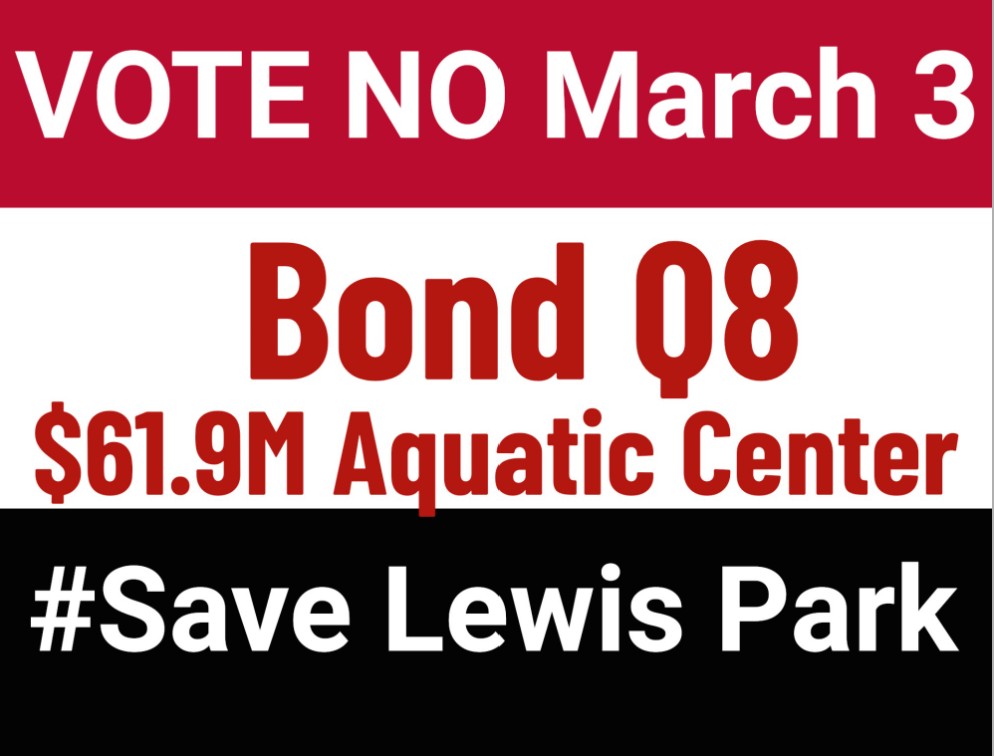
VOTE No Bond Q#8 -March 3
We are asking for your support to Save Lewis Park by voting NO to the $61.9 Million Aquatic
The 2026 Bond Issues in order of $$
When considering what bonds to support in the March election, viewing them in order of expense might change

